Does it make sense to buy refurbished company phones? Opinions are divided.
For some, it's a no-brainer on price and performance, especially as new devices keep getting more expensive – hello, memory shortage.
Others view equipping staff with refurbished smartphones critically: they're not on the latest technology, which moves fast in smart devices, and someone else has already used them. Not everyone likes that "used" aspect.
Refurbished is better than its reputation, even for company phones
We hold our phones to our faces and sometimes take them to bed. No wonder a used company phone feels odd to some people at first. Hardly any device is as close to us as the smartphone, which is exactly why the hurdle for used ones is high.
Residue-free cleaning during refurbishing
The reluctance is unfounded, though: during refurbishing, devices are not only tested technically and reset, but also cleaned down to the pores.
Charging port, speaker and microphone openings, buttons and SIM tray are cleaned with fine brushes and cleaning putty. The housing, back and display are wiped with isopropyl alcohol. That removes grease, fingerprints and residue without damaging the coating or the display. No dirt is left, and you should tell your users that, to take the hygiene concerns out of the discussion.
Used devices that are fit for use
Now the technology. "Refurbished" does not mean "outdated". Smartphones have become so powerful in recent years that, apart from pure entry-level models, their hardware is more than enough for everyday tasks like email, photos, messaging and, of course, calls, even when they are a few years old.
Refurbished company phones are therefore good enough for most office and field-service jobs. From a purchasing point of view, two things matter most:
- the battery and
- the security updates for the planned period of use.
More on both in a moment.
The term "refurbishing" is not uniformly regulated, by the way, and every provider defines grades such as A, B or C for itself. Two devices with the same label can therefore differ quite a bit from one provider to another.
Interim conclusion: "refurbished" on its own says little about quality and suitability as a company phone.
Our view: what counts is what the provider tested and replaced before resale, and what they commit to in writing.
What refurbished means and what it doesn't
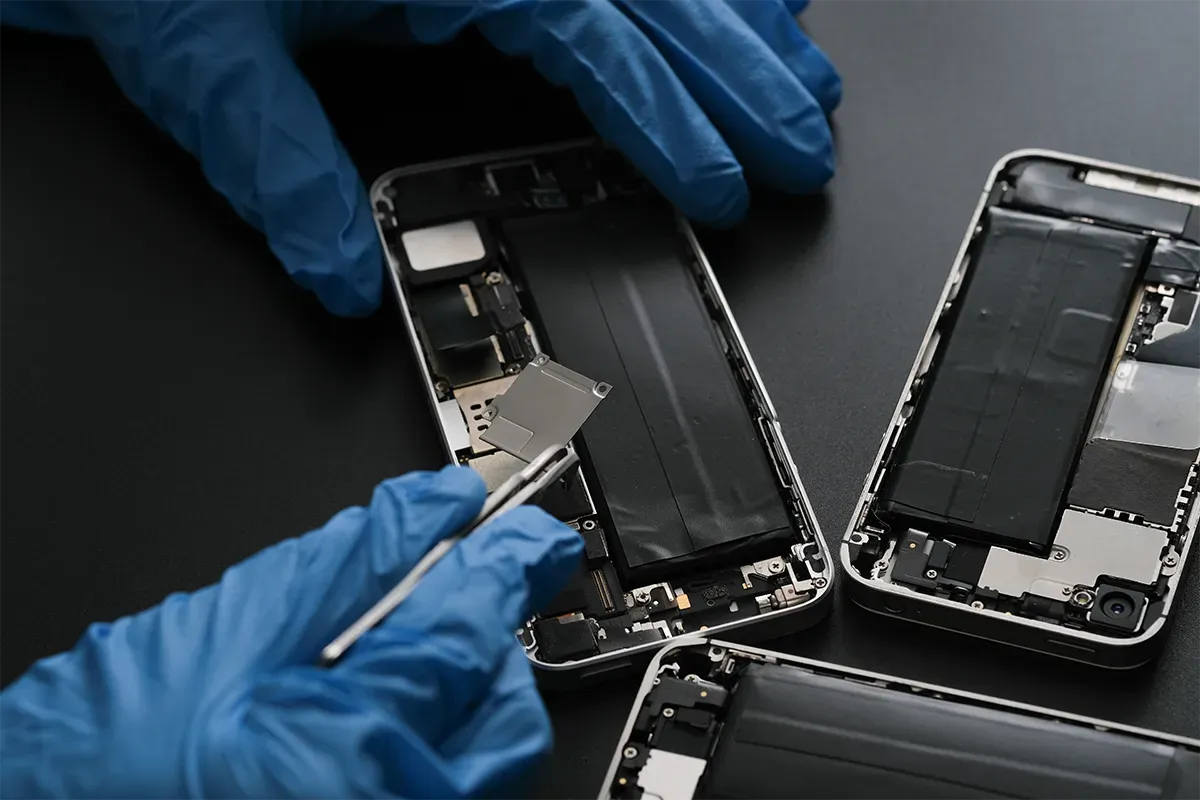
A refurbished device has had its data erased, its function tested and, where needed, wear parts replaced – usually the battery, sometimes the display. Whether and what exactly gets renewed is something the provider has to tell you.
You can tell a refurbished device from a merely used one by the documentation. Proper refurbishment comes with a test report. With "used, checked" you often get only the promise that the device switches on.
Recycling is a different thing. It recovers metals from old devices, and the device itself is gone afterwards. Our article on buying refurbished phones explains the differences.
The battery decides how usable the phone is day to day
The battery is where refurbished devices disappoint most often in daily use. A display can be scratched without anyone noticing. A battery that gives up after lunch is noticed by everyone immediately.
The EU offers a benchmark. For new smartphones placed on the market since June 20, 2025, the Ecodesign Regulation (EU) 2023/1670 requires the battery to retain at least 80 percent of its original capacity after 800 charge cycles. It doesn't apply to older devices, but you can use it as a yardstick.
So ask for a fixed threshold: at what battery condition does the provider replace the battery before passing the device on? On iPhones you can read the value yourself under "Battery Health". A provider that names no number probably has none.
If your field staff navigate and take photos all day, a fresh battery matters more than a new casing. A device with signs of use and a new battery beats a flawless one with an old battery.
Security updates: how old can a device be?
A refurbished device is only as secure as the updates it still receives. That is the most important figure for business use, and it depends on the model, not on the condition.
With Apple, iOS 26 runs on all iPhones from the iPhone 11 onwards. The iPhone XR or XS, by contrast, only gets security updates for the older iOS 18 branch. For Android, the update commitment for the specific model is listed on the manufacturer's support page. For planning security, "Android Enterprise" devices also have particularly long, firmly committed update cycles, which helps IT buyers.
Work backwards. If you plan three years of use, the device should logically still receive updates for at least three more years. If the model is already five years old and has only one year of support left, it doesn't fit, no matter how cleanly it was refurbished.
A mobile device management system that keeps all devices at the same patch level catches this. It does not replace updates the manufacturer no longer delivers.
Warranty and statutory liability for used devices
Under German law, the statutory warranty (Gewährleistung) on used goods sold to consumers can be shortened to one year. In business-to-business sales, it can be limited or excluded even further by contract. For you that means: don't rely on the law, and get the duration and scope of the warranty in writing. Ask about the battery in particular, because some providers treat it as a wear part and exclude it.
With rental, things are simpler, at least at Everphone. Damaged devices are part of the service and damage is covered by the rental fee, so you don't have to enforce warranty claims against a retailer. If a device stops working properly, and a battery life that is too short counts as that, it is replaced without fuss and free of charge. With a purchase, that stays with your IT team.
Data erasure before first use
A refurbished device has already had an owner. The question is not whether the data was erased, but how that is proven. A factory reset from the menu isn't enough.
Ask for an erasure certificate per device before it enters your inventory. How clean erasure works and which proofs count is covered in our article on secure data erasure when returning devices. At Everphone, certified erasure and refurbishment after return are part of the service at no extra cost.
Also check whether devices were removed from the previous owner's device management before they were passed on. Otherwise a device stays tied to someone else's company ID and can't be set up.
What refurbished does for the environment
Manufacturing causes most of a smartphone's emissions. A study by Fraunhofer UMSICHT, commissioned by Interseroh, arrives at around 58 kg of CO₂ equivalents and 14 kg of resources per device when refurbishment extends the period of use from two to four years (Fraunhofer study from 2018). A more recent study from 2025 puts the saving at about 37 percent fewer greenhouse gases compared with a single conventional life cycle (Fraunhofer UMSICHT).
The two values are not directly comparable, because assumptions and system boundaries differ. They do point in the same direction.
Take a company with 200 smartphones. If it extends the use of each device from two to four years through refurbishment, that comes to around 11.6 tonnes of CO₂ equivalents that are not additionally emitted, based on the Fraunhofer calculation. That only holds if the second life really happens. A refurbished device that sits in a drawer after one year saves nothing.
For more on how return, refurbishment and resale fit together, read the article on the circular economy for IT hardware.
Checklist for comparing providers
| Check | Your question | Warning sign |
|---|---|---|
| Battery | At what condition is it replaced? | No number, just "tested" |
| Updates | How long will this model still get security updates? | Model older than your period of use |
| Warranty | How long, and what is excluded? | Battery and display excluded |
| Data | Is there an erasure certificate per device? | Factory reset only |
| Test report | Can I see it per device? | Grade without criteria |
Who should use refurbished company phones
Refurbished company phones are worth it for anyone who needs devices for office, sales or service work in larger numbers and doesn't need the latest models. You get the same work device, you conserve resources and you don't pay premium prices.
They are not worth it if the model no longer covers the planned period of use with updates, or if you need specific hardware features that only the newest generation has. In that case, choose new devices; a Device as a Service approach like Everphone's suits this too, because it plans fleet modernization through regular upgrades to newer model lines from the start.
At Everphone, the second life cycle runs through the return: devices come back, are erased with certification and refurbished. Until then, the checklist above applies to us as well. Ask about it.
Frequently asked questions
Are refurbished smartphones secure for businesses?
Yes, if the model still receives security updates and the previous owner's data has been demonstrably erased. Security depends on the model and the erasure proof, not on the word "refurbished". A mobile device management system also keeps the devices at a uniform level.
How long does a refurbished company phone last?
That depends on the battery and the update commitment. If the battery has been replaced and the model still runs current software, a device usually carries this second phase of use without any loss in daily use.
What is the difference between refurbished and used?
Used means the device had a previous owner and is resold, often only cleaned. Refurbished means it was also tested, erased and, where needed, fitted with new parts. The term is not formally defined, which is why the test report counts.
What happens to the previous owner's data?
It must be demonstrably erased, ideally with a certificate per device. A reset to factory settings isn't enough as proof. Ask for the certificate before the device enters your inventory.