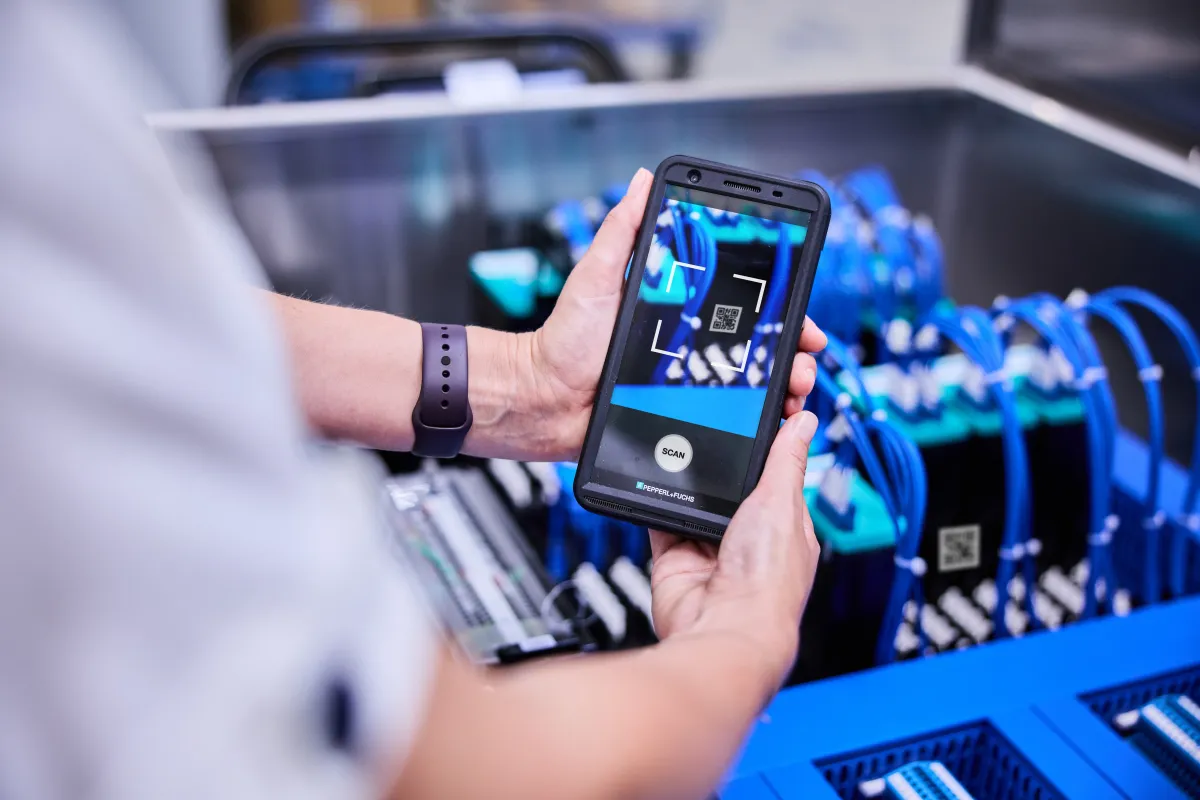
Our partner Pepperl+Fuchs’s “Enterprise Mobility” concept redefines connectivity in industrial environments. It is a holistic, all-in-one architecture that seamlessly integrates hardware, mobile device management (MDM), 5G connectivity, and strategic infrastructure partnerships.
For solutions architects today, the priority is no longer simply equipping frontline workers with devices - these devices must be established as an integral part of the IIoT infrastructure. This bridge between the field and control levels achieves a new level of safety and efficiency, for example in the chemical, pharmaceutical, and oil industries.
“Our integrated solution portfolio connects infrastructure, devices, and people. This creates the flexibility and productivity companies need while reducing total cost of ownership (TCO) and maintaining the highest safety standards in hazardous areas”, says Hendrik Haag from Pepperl+Fuchs.
Connectivity Foundation: 5G, Network Slicing, and Wi-Fi 6
Next-generation industrial communication rests on three technological pillars tailored specifically to the requirements of hazardous locations (HazLoc):
Public Networks - Global 4G LTE and 5G networks offer broad coverage for mobile service deployments.
Private/Campus Networks - These dedicated networks use specific RF bands (e.g., CBRS Band 48 in the US or 5G n48) to create an exclusive infrastructure with wide coverage and data sovereignty.
Network Slicing - Based on 3GPP Release 15/16, 5G enables multiple virtual, independent networks to run on shared physical hardware. This is critical for quality of service (QoS), since business-critical applications (e.g., emergency call systems) can be prioritized over general data traffic.
Comparison: 5G Campus Networks vs. Conventional Wi-Fi
Feature | 5G Campus Network | Conventional Wi-Fi |
Coverage area | Very large (few macro cells for wide areas) | Limited (high access point density required) |
Security | Highest (SIM-based authentication) | Protocol-based (WPA2/3), more vulnerable |
Latency | Minimal & deterministic (URLLC) | Variable (“best effort”) |
Quality of service | Dedicated slicing possible | Limited by media access conflicts |
Mobility | Seamless handover (high-speed) | Risk of connection drops during roaming |
Hardware Analysis: High-Performance Processors and Platforms
Modern IIoT scenarios demand computing power once reserved for desktop systems.
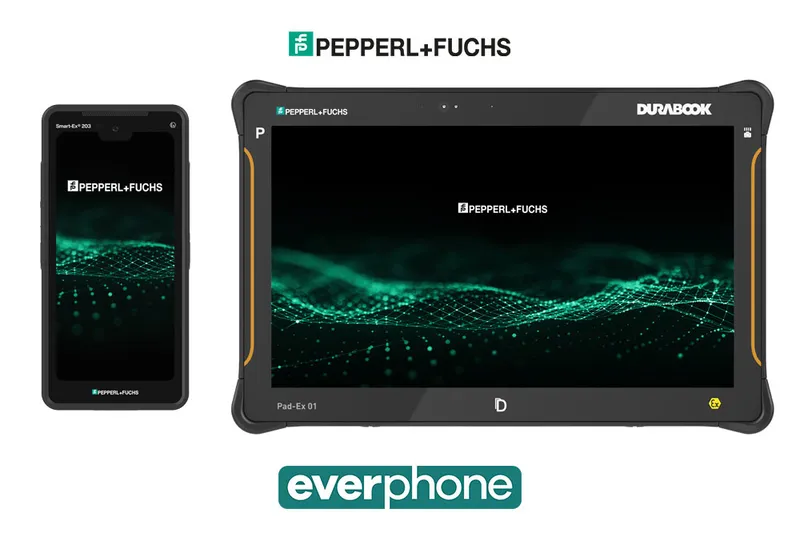
Pepperl+Fuchs’s explosion-protected devices rely on specialized chipsets for on-device AI and real-time processing:
Qualcomm QCM6490 (Smart-Ex 03) - A high-tier processor with an integrated AI engine, optimized for demanding tasks and global 5G connectivity (3GPP Rel. 15).
Qualcomm QCM4490 (Smart-Ex 203) - Designed specifically for Zone 2, this chip fully supports 3GPP Release 16, ensuring state-of-the-art network compatibility.
12th Gen Intel Core i5 (Pad-Ex 01 P12) - Based on the Intel Alder Lake platform, is CPU, combined with Intel Iris Xe graphics, delivers the performance required to process massive data streams and high-resolution video feeds under Windows 11 Pro.
Detailed Device Matrix: Smartphones and Tablets
Model | Zone Rating / HazLoc | Operating System | Physical Features | Processor | Highlights |
Smart-Ex 03 | Zone 1/21, Div. 1 | Android 15 (update to A16 committed) | 6”, Gorilla Glass 3, 400 g | QCM6490 | Fingerprint sensor, desktop mode, 5G |
Smart-Ex 203 | Zone 2/22, Div. 2 | Android 14 (update to A16 committed) | 6.3”, Gorilla Glass 3, 365 g | QCM4490 | 48 MP camera, 3GPP Rel. 16, 5G |
Tab-Ex 05 | Zone 1/21, 2/22, Div. 1/2 | Android 15 (update to A22 committed) | 8”, TFT WUXGA, 1,200 g | Exynos 1380 | S Pen, update guarantee through 2032 |
Pad-Ex 01 P12 | Zone 2/22, Div. 2 | Windows 11 Pro | 11.6”, 1,000 nits, IP64 | Intel Core i5, 12th Gen | Thunderbolt 4, Iris Xe graphics |
Security Architecture and Device Health Monitoring
The Smart-Ex 03 series marks a turning point in operational safety through innovative hardware and software self-monitoring.
This device health monitoring enables continuous condition monitoring: errors are detected predictively - before they lead to failure.
Another unique feature in hazardous areas is the fingerprint sensor integrated into the power button. It enables biometric multi-factor authentication (MFA) that is both secure and practical under field conditions.
Android Enterprise Recommended (AER) certification further guarantees compliance with the strictest IT security standards.
Important: Extended support cycles provide maximum investment security. For the Smart-Ex 03, security updates are guaranteed until October 2030 (every 90 days). The Tab-Ex 05 series and the Smart-Ex 203 set new standards with security updates through 2032 and upgrades up to Android 22, respectively.
Practical use cases and application areas
Augmented Reality (AR)
Thanks to Google ARCore certification and powerful camera systems, digital twins or maintenance instructions are displayed directly in the worker’s field of view.
Hardware features: QCM6490/Snapdragon SM7325-2-AB, AR-capable 13 MP/48 MP cameras, gyroscope.
Desktop replacement (DeX/Desktop Mode)
The Smart-Ex 03 is the only intrinsically safe smartphone on the market that offers a full desktop mode via its USB 3.1 Type-C port. It replaces the PC in the office, reducing hardware diversity and costs.
Hardware features: USB 3.1 Type-C, multiport adapter support for monitor and keyboard.
Troubleshooting
Mobile workers use 5G devices as a mobile HMI for Ethernet-APL-capable field devices. Using unique identifiers, the device pulls real-time data directly from the sensor for immediate on-site diagnostics.
Hardware features: 5G connectivity (n48/Band 48) for minimal latency when accessing field data.
Communication: PTToC
Push-to-Talk over Cellular (PTToC) replaces conventional radios with encrypted group calls over 5G, ensuring global reachability with minimal latency.
Hardware features: Dedicated, programmable PTT button, optimized audio interfaces for Ex headsets.
Software ecosystem: Digital products and services
The efficiency of a mobility solution is decided at scale.
Combining Pepperl+Fuchs devices with Everphone’s Device-as-a-Service largely automates staging and management, minimizing total cost of ownership (TCO):
Pre-configuration (eCSL) - Customer-specific security settings and apps are installed at the factory (Custom Service Load).
Automated registration - Via Android Zero-Touch, devices are automatically enrolled into the corporate environment the first time they’re switched on.
Central management (MDM) - Worldwide over-the-air updates and configuration without physical access.
Deployment
Conclusion: Investment protection and future-proofing
Pepperl+Fuchs’s architecture offers more than just rugged hardware. The synergy of worldwide certifications (ATEX, IECEx, NEC/CEC), state-of-the-art 5G technology (3GPP Rel. 16), and an unmatched update guarantee through 2032 creates a future-proof platform for Industry 4.0.
As a strategic partner, we support companies with DaaS in scaling the mobile worker into the heart of their digital transformation.
Weblinks Enterprise Mobility in Hazardous Areas
Pepperl+Fuchs and Everphone partner to expand mobile device offerings (Automation World)
Pepperl+Fuchs and Everphone launch partnership for industrial mobility (Industrial Technology)