
What does buying on installment mean?
First, a short definition: what is an installment plan for a phone? An installment plan usually refers to the purchase of a product that is then paid off "piece by piece".
Instalment sales
Legally, this is called an installment sale, sometimes also known as a financed purchase. It is essentially a financing solution in the retail trade in which the seller and the consumer agree that the purchase price will be paid in partial payments. Colloquially, these partial payments are called installments.
The customer therefore pays a fixed monthly amount to the seller. For larger purchases there are often down payments and a larger final installment. This form of sale is often treated like a loan and carries a specific interest rate, although "zero percent" financing is currently very common in retail. The term for a phone installment plan usually runs between 12 and 36 months.

Zero percent financing
More and more retailers advertise so-called zero percent financing. Also for smartphones: iPhone installment plans are often marketed as zero percent.
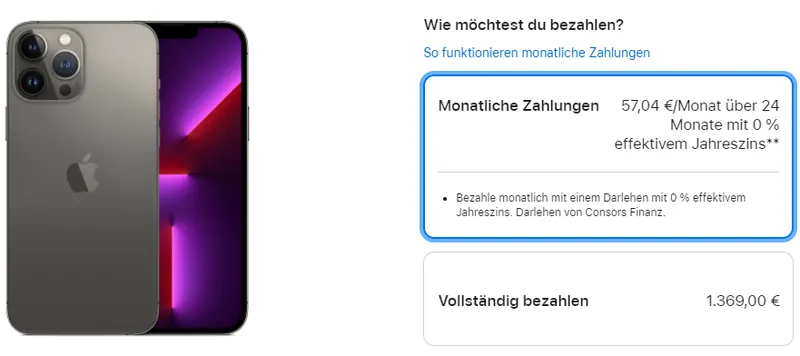
Screenshot from the Apple Store for installment purchase
Consumers can then set up an installment plan without paying interest. In practice, however, these contracts often come with additional fees. These are not counted in the effective interest rate, but are still paid by the consumers.
Financing and interest
As mentioned, smartphone financing via installment plan usually incurs interest. This tracks current lending rates, so it is relatively low right now (between 2.5 – 7.5 percent). However, this may change in the future, especially given the current inflation situation in the eurozone. At smartphone prices of several hundred or even more than a thousand euros, interest can quickly add up — depending, of course, on the model.
Smartphone installment plans from the carrier
Mobile carriers also offer devices, often with zero percent financing on smartphones, smartwatches and tablets.
Also read: Renting a tablet — using expensive devices affordably
Sometimes customers can decide how much of the smartphone price they want to pay initially — the rest of the purchase price is then spread over the contract term, usually 24 months.
"Smartphone for 1 euro"
Many people know the mobile offers where a brand-new smartphone is offered for just one euro. Of course, that is nonsense. Only the one-off down payment is one euro (sometimes even 0 euros). The monthly installments are naturally higher.
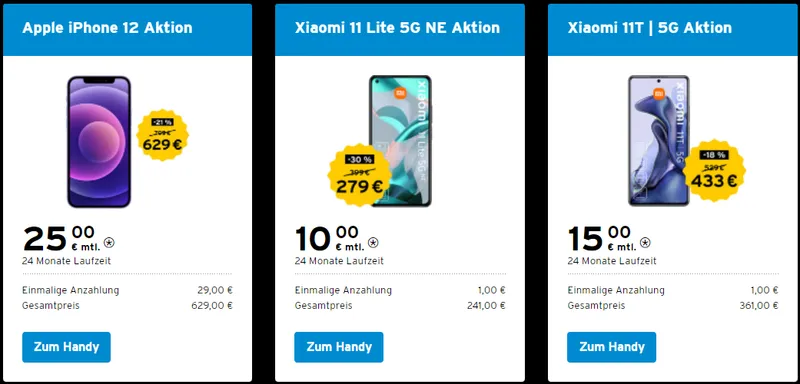
Advertising from carrier Congstar for smartphone bundles with installment plan
Bundle vs. SIM-only
So, again: only the initial installment is one euro. For advertising purposes this argument is of course extremely effective.
Bundle offers: tariff and installment plan
After that, these bundle offers combining a mobile plan and device charge a significantly higher premium for the device. Mobile carriers, too, don't give anything away.
The monthly installments in a purchase plan are usually structured so that they closely reflect the retail price of the device. In the Congstar offer above, for example, for the Xiaomi 11 Lite 5G:
One-off payment = EUR 241
Installment plan: (24 x EUR 10) + EUR 1 down payment = EUR 241 total price
Sometimes the installment plan is actually a bit cheaper. Consumers therefore do well to carefully compare installment offers for high-quality devices like iPhones or Samsung Galaxy models.
But watch out: as soon as you stay in this bundle contract even a little longer than necessary, you keep paying for a smartphone that has already been fully paid off. Almost always there is a tacit contract extension.
If you do nothing, the contract and installments for the already-paid-off device simply keep running. If you are lucky, the contract can be cancelled with one month's notice after the end of the minimum term. But there are also significantly longer cancellation periods — and then the supposed smartphone installment bargain becomes really expensive. So you should keep a close eye on the contract term, otherwise you will definitely pay too much.
SIM-only
At Everphone, we usually advise our business customers to procure SIM-only plans and mobile devices separately — this allows for more cost transparency and usually more flexibility than the coupled bundle offers.
For our business customers, we therefore not only handle hardware procurement but, in direct cooperation with the mobile network operators in Germany, also arrange suitable SIM-only business plans.
Phone installment plans and cost transparency: TCO
When determining costs for an installment plan (TCO = Total Cost of Ownership), you should not only keep possible interest for the financing in mind. Not infrequently there are additional fees at various points of the installment purchase that drive up the total cost of the device.
Take internal costs into account
You should not forget that if problems occur with the device, the seller often provides little to no help. Phone installment plans can therefore quickly become a cost trap for companies, because the internal costs for repairs and other tasks around device management usually involve a whole series of internal and external actors (e.g. IT department, help desk, accounting, office management, insurance, phone repair shop, etc.) and cause astonishingly complex processes.
Everphone CEO Jan Dzulko explains the processes around the smartphone (in English)
Are installment plans and leasing the same thing?
No, leasing and installment plans are not the same. With leasing, you essentially borrow the device from the seller at a pre-defined rate. The big difference: at the end you do not become the owner — the device goes back to the seller.
However, leasing also offers some advantages compared to installment plans. You only pay VAT on the individual installments and not on the total price, which can save money.
You also usually have the option to buy the device at a reduced price (residual value) at the end of the leasing contract. Again, VAT does not apply to the new price. Nevertheless, there are quite a few arguments against leasing. Also read: 9 reasons why smartphone leasing costs are too high
"Device-as-a-Service" — an alternative to phone installment plans?
With Device-as-a-Service you can imagine a kind of all-round service for smartphone procurement in which you get more than just the device.
Typically, Mobile Device Management (MDM) is also installed on the device and further protective measures are taken to protect your company's data against unauthorized access.
Also read:
Device replacement included
You are also not left alone in the event of damage: as a Device-as-a-Service provider, Everphone replaces defective devices immediately without delay or extra charge. Employees can stay productive. The defective device is meanwhile cleaned of any remaining data by Everphone in the background and reconditioned ("refurbished") for environmentally friendly reuse.
Company smartphones on subscription: use instead of own
That is why at Everphone you don't buy the device but simply rent it as needed. When an employee leaves, the rental ends and the device is returned — case closed. This way you can always perfectly adapt your device fleet to your needs.