TCO calculator for company smartphones
The purchase price of a corporate smartphone tells you very little about its real cost. Insurance, repairs, administration, and returns often add up to more than the device itself.
A TCO calculator for (company) smartphones makes these total costs visible — across the whole usage period and across every procurement model.
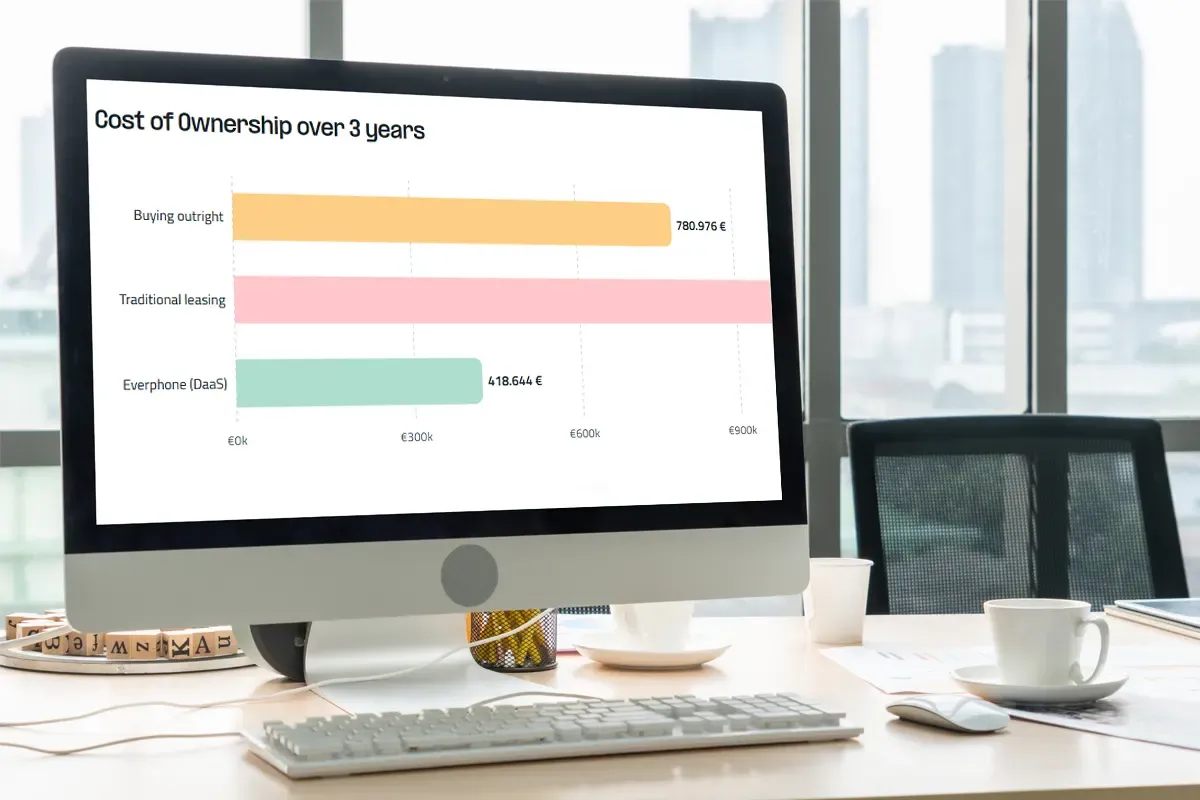
This article walks through the cost factors that belong in a smartphone TCO calculator, then compares buying, leasing, and Device as a Service (DaaS) side by side. The comparison stays deliberately abstract: it shows cost structure and tendencies, not a specific vendor's pricing.
However, if you do want to forecast actual numbers for your company: Go to the Everphone TCO calculator. It will produce an actual forecast for you.
What is a TCO calculator for smartphones?
TCO stands for Total Cost of Ownership — the full cost of a device over its entire lifecycle. A TCO calculator adds up everything beyond the sticker price.
That includes the mobile plan, insurance, repairs, administration, data wiping, disposal, and the effort of reassigning devices when employees join or leave. Tied-up capital and lost productivity from device downtime count too.
The basic formula:
TCO = purchase or rental cost + operating cost + cost of capital + downtime cost − residual value
A low purchase price or an attractive lease rate says nothing about actual TCO on its own. Only the full picture across every cost category shows which procurement model truly pays off.
Three ways to procure corporate smartphones
Companies generally have three procurement options. (Read more on the three device procurement options here.)
Buying
With a classic purchase, the company acquires the devices outright — through system integrators, distributors, mobile carriers, or retail. The device belongs to the company, and the full investment is due immediately.
Leasing
With leasing, the company pays a monthly rate over a fixed term, typically 24 to 36 months. The leasing company retains ownership. At the end of the term, the company returns the devices or buys them at residual value.
Device as a Service (rental)
With Device as a Service, the company rents devices including service. Insurance, repair, replacement, and administration are part of the monthly rate. Contracts are usually easier to adjust than classic leasing.
Cost factors in a smartphone TCO calculator
A complete TCO calculator accounts for far more than the purchase price or the monthly rate. The most important variables:
Purchase or rental cost. The baseline of every calculation — a one-time cost when buying, spread across the term with leasing and DaaS.
Cost of capital. Buying ties up capital immediately (Capex). Leasing and DaaS shift the cost into operating expenses (Opex) and protect cash flow.
Insurance and damage. Who covers the cost of loss, theft, or a cracked screen — and how fast does a replacement device arrive?
Repair and downtime. Repairs cost money and time. Every day without a working device costs productivity.
Asset management and admin effort. Who tracks which device is assigned to which person? The software for that is rarely free.
Residual value and returns. With a purchase, resale value determines the remaining cost. With leasing, the device's condition at return determines whether a penalty charge applies.
Data wiping and disposal. Certified data erasure and proper disposal are mandatory — and often billed as a separate line item.
Tax treatment. Buying, leasing, and renting are all tax-deductible, but they differ in how they're booked (Capex vs. Opex).
Employee turnover and scalability. How easily can a device be reassigned when someone leaves the company or the fleet grows?
Buying vs. leasing vs. Device as a Service: the abstract cost comparison
The table below shows the typical cost structure of all three models — independent of any specific vendor or price.
Cost factor | Buying | Leasing | Device as a Service |
|---|---|---|---|
Upfront investment | High | None | None |
Cost type | Capex | Opex | Opex |
Contract commitment | None | Fixed, often with a collection period | Usually flexible |
Insurance | Organized separately | Often optional, at extra cost | Usually included |
Repair/replacement | Company's own effort | Included in the service package, often slow | Included, usually fast |
Asset management | Own effort or extra cost | Frequently a paid add-on | Frequently included |
Residual value risk | Borne by the company | Usually borne by the company (grading) | Usually borne by the provider |
Return effort | None (ownership) | High, with penalty risk | Low |
Scalability | Low | Medium | High |
Cost predictability | Medium | Medium, hidden costs possible | High |
The pattern is clear: buying demands high capital but gives full control. Leasing looks cheap upfront but shifts risks like returns and device condition onto the company. Device as a Service bundles service and risk into one predictable rate.
Hidden costs most TCO calculations miss
Leasing in particular tends to carry costs that never make it into the initial calculation. (Read more about the hidden device leasing costs here.)
The collection period. Many leasing contracts add extra months before and after the actual term, quietly turning 24 months into 24 plus 3.
Bundled returns. Devices are often billed in large batches. If even one device is missing on the due date, payments continue for the entire batch.
Grading penalties. If a returned device doesn't meet the required condition, a penalty charge applies — in some cases up to half the price of a new device.
Add-on services. Certified data erasure, disposal, and asset management are frequently billed separately and, spread over actual usage time, often cost more than expected.
A TCO calculator is only as good as the cost items it includes. Ignoring these line items means underestimating the real total cost, regardless of which model a company chooses.
How to calculate smartphone TCO in four steps
List every cost category. Purchase or rental cost, mobile plan, insurance, repairs, administration, data wiping, disposal.
Set the time period. Usually the planned usage period — typically 24 to 36 months.
Convert costs to a per-device, per-month figure. This makes buying, leasing, and DaaS comparable regardless of payment structure.
Factor in residual value and return costs. Only then do you get a complete picture instead of an optimistic headline price.
Frequently asked questions about smartphone TCO calculators
What's the difference between purchase price and TCO? The purchase price is just one line item. TCO also covers operations, administration, insurance, downtime, and residual value across the entire usage period.
Is buying or renting cheaper? It depends on usage duration, fleet size, and internal administrative effort. Buying can look cheaper over very long usage periods, but it shifts risk and effort onto the company. Renting bundles service and risk into one predictable rate.
Why does leasing often look cheaper than it actually is? Because offers usually show only the plain monthly rate. Collection periods, return effort, grading penalties, and add-on services often stay invisible in the initial calculation.
What belongs in a complete smartphone TCO calculation? Purchase or rental cost, insurance, repair, asset management, data wiping, disposal, cost of capital, tax effects, and residual value or return costs.
How does Device as a Service lower total cost? By bundling service, insurance, and administration into the rate from the start. That reduces hidden add-on costs and makes the monthly cost predictable.
Conclusion
A TCO calculator for smartphones pays off whenever more than the sticker price matters. Buying, leasing, and Device as a Service mainly differ in who carries which risk — cost of capital, residual value, returns, or administrative effort.
Factoring in every cost category, instead of looking only at the first price on offer, leads to a well-founded decision — whichever procurement model a company ultimately chooses.