
Private numbers are sacred to many
There are people who shrug and swap their phone number with every change of mobile carrier or plan — as casually as slipping on a fresh pair of socks.
Others have had their phone number since the late nineties and could never let it go. They have had it so long they can recite it in their sleep. Mum knows it by heart, and their spouse has also memorized this — somehow beautiful — sequence of digits.
We are sure: for many people the mobile number is a cherished piece of data they have carried around for years or even decades and definitely do not want to change lightly.

All of our rented company phones are dual-SIM-capable and usable privately.
Request our non-binding price list here!
Company phone? Yes. But please with dual-SIM!
For this reason many people are skeptical when their employer offers them a company phone. The offer seems to lead into a dilemma:
You have to use the number of the corporate mobile plan and essentially give up your own number
= bad.You have to use your private number, hand it out to business contacts and then deal with billing and tax aspects
= bad.You cannot use the company device privately at all. That means you keep your number, but then you need two phones you have to carry around all the time
= doubly bad.
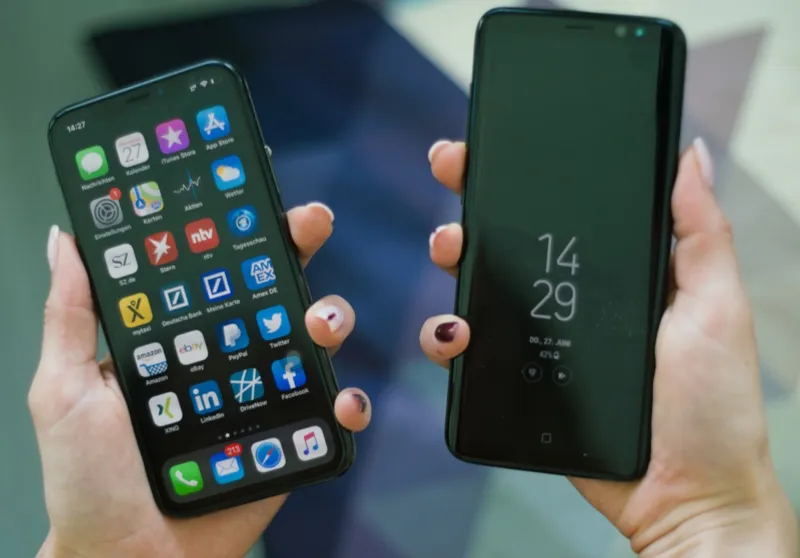
Nobody likes to carry two phones — why would they?
For the scenario in which the company phone is to be used both for business and private — the only truly user-friendly scenario — dual-SIM smartphones offer a real solution. Both under Android and under iOS.
Dual-SIM: "both/and" instead of "either/or"
A dual-SIM-capable smartphone is handy for cost-conscious users who want to use an additional cheap data plan, or for people who prefer to use a local mobile plan when abroad.
Since this does not necessarily suit the interests of the carriers, dual-SIM devices in Germany were for a long time in a kind of sleeping-beauty slumber. In many other countries dual-SIM has long been a standard feature. But in Germany, too, the situation is slowly improving, and there are more and more dual-SIM smartphones.
Apple and Samsung in particular have caught up significantly since 2018.
[Edit 2023: today virtually all upper-mid-range and premium smartphones are dual-SIM-capable.]
The iPhone 11 and 11 Pro models are — like their predecessors X and Xs — dual-SIM-capable.
Handy for business phones
The concept is especially convenient for employees who want to run their company device with their own private number. This is also great for productivity and employee retention — see: The company phone as an employee benefit.
With dual-SIM devices, employees can use both their private and their business number on one device at the same time. In practice this is quite straightforward if you pay attention to a few aspects.
As the name suggests, dual-SIM is implemented via two physical SIM cards — or by an additional eSIM, as is the case with Apple devices from generation X onwards. So there are already differences here.
What to look for with dual-SIM
When procuring a dual-SIM device it is worth reading the small print of the technical specifications and data sheets and comparing them precisely with the usage profile and its requirements. A few aspects to consider:
1. High-quality SIM slots: 3G, LTE, 5G
Not all SIM slots are equal. Slots supporting the currently fastest transmission standard, 5G, are desirable.
On many devices only one of the two SIMs supports 5G. The second slot is then usually 4G.
On older devices that don''t yet handle 5G, only one card slot supports fast LTE/4G. The second slot is often only 3G- or 2G-capable.
In certain scenarios that is fine. But if you want to surf the mobile internet quickly and make calls with both SIM cards, you should make sure that one slot supports 5G, or that at least both slots support LTE/4G. On Huawei devices, for example, this feature is called "Dual 4G SIM".
2. Using an eSIM on iPhones
On the iPhone X, iPhone Xs and successor models, an eSIM can be used as the second SIM card. There is therefore only one physical card slot, not two.
This in turn means: the carrier of the planned mobile plan must also support eSIM, which is not always the case. This must, of course, be taken into account when selecting the plan.
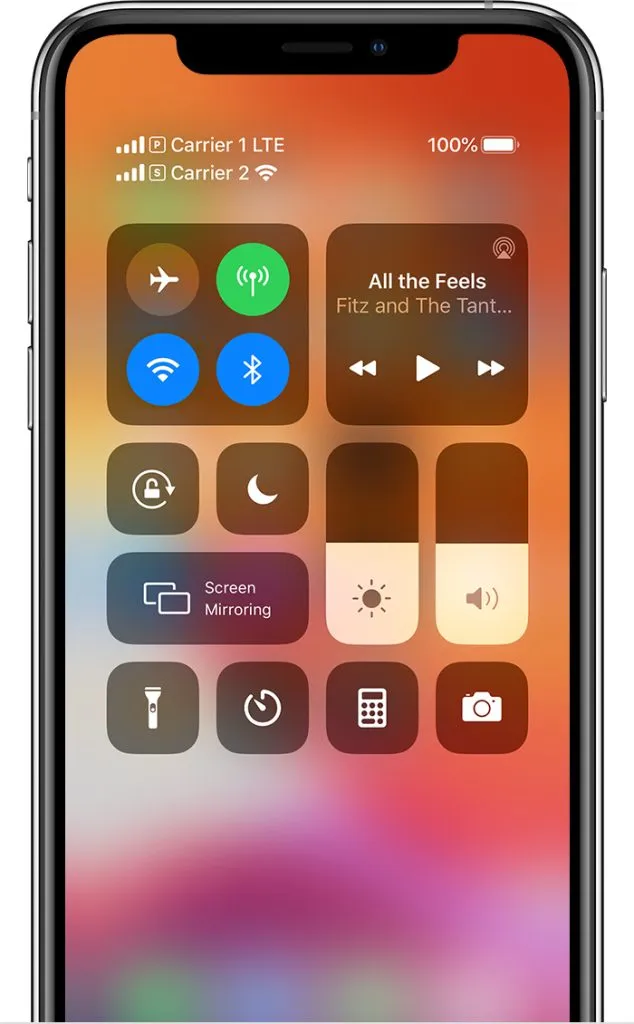
In Control Center under iOS 13 the SIM configuration was shown at the top. Screenshot: Apple
More details on the topic of eSIM are provided by Apple Support: Use dual-SIM with an eSIM.
3. Hybrid slot: nano-SIM vs. microSD
On some Android devices a so-called hybrid slot is used, for example on the Samsung Galaxy S10. Here, users can either insert a second SIM card into the slot or expand the device''s storage with a microSD card.
The "or" is decisive: if you want to use two SIM cards permanently, you should therefore opt for a device with sufficient internal storage from the outset, since the option to expand storage via microSD then no longer exists.
4. Dual-SIM active or dual-SIM standby?
Another important difference concerns the actual usage possibilities (usage profiles) of the two SIM cards: can the cards be used at the same time? Can calls be forwarded and juggled? Depending on user behavior, this can make life much easier or considerably harder.
The fundamental difference lies in the hardware. The question is whether the smartphone has only one transceiver unit or actually two of these modules.
Dual-SIM active
Here there are two transceiver modules. Both SIM cards are therefore simultaneously ready to send and receive. In principle it is possible to juggle calls between the two numbers and put callers on hold.
This is ideal if you make lots of calls and don''t want to miss any: you can decide whether to take a call, briefly announce a callback on the second line while the first caller is put "on hold".
Dual-SIM standby
With dual-SIM standby the second SIM card cannot be reached while a call is running on the first. Reason: there is only one transceiver. As a rule, the person calling in is informed by SMS about the missed call.
On some models call forwarding can be activated, so the user can decide whether to take the second call when it comes in. This variant is likely to be enough for many users, but for power users it can be annoying.
5. SIM card management
Also pay attention to SIM card management. There are sometimes significant differences in which settings can be made. Examples: assigning different ringtones to numbers, assigning specific roles (calls only vs. data only vs. mixed), or deactivating individual SIM cards.
Dual-SIM settings even back on Android 9.0 (screenshot: Everphone)
Devices with dual-SIM function (selection)
Now to the devices. Since 2018 there has been a real boom in dual-SIM devices. First, Apple joined the dual-SIM train; second, industry leader Samsung significantly expanded its dual-SIM portfolio. Huawei, Sony, LG, OnePlus and Honor also offer dual-SIM smartphones, plus a number of smaller manufacturers.
Dual-SIM at Samsung
Meanwhile all current top-end models of the Samsung Galaxy S range have the dual-SIM function. The Galaxy S20, S21+ and S20 Ultra range also offered the feature, including the "Fan Edition" Galaxy S20 FE. The Samsung Galaxy S10, S10e and S10+ smartphones also had the function on board as a standard feature.
| Historical: Before that Samsung offered so-called DUOS variants for the Galaxy S9, S9+, S8+, Note8 and models of the J series. Here you had to pay attention to the exact model designation. |
Dual-SIM at Apple
Apple supports dual-SIM in the following models, among others:
iPhone 15
iPhone 15 Plus
iPhone 15 Pro
iPhone 15 Pro Max
iPhone 14
iPhone 14 Plus
iPhone 14 Pro
iPhone 14 Pro Max
iPhone 13
iPhone 13 Pro
iPhone 13 Pro Max
iPhone 13 mini
iPhone 12
iPhone 12 Pro
iPhone 12 Pro Max
iPhone 12 mini.
The predecessor models
iPhone 11,
iPhone 11 Pro,
iPhone XS,
iPhone XS Max and
iPhone XR
also offer a dual-SIM function that combines a physical SIM card with an eSIM.
Dual-SIM at Google
Google equips the following models of the Pixel range with dual-SIM:
Google Pixel 8 Pro
Google Pixel 8
Google Pixel 7 Pro
Google Pixel 7
Google Pixel 6
Google Pixel 6a
Google Pixel 5
Google Pixel 4
Google Pixel 4 XL
Other dual-SIM devices
Other popular models with dual-SIM included:
Honor 8x
Sony Xperia Z5
Huawei P30 Pro
LG V40 ThinQ
Conclusion: combining business and private with dual-SIM
Price-wise, dual-SIM devices differ hardly at all from regular smartphones. For companies that want to offer their employees a great smartphone as a benefit, a dual-SIM device paves the way if employees want to keep their own number. If employees can also pick their own device (keyword: Choose Your Own Device), the supposedly unloved company device suddenly becomes a real perk.
Clean separation of the data flows is uncomplicated today, user guidance is usually clear and intuitive, and via Mobile Device Management and Mobile Application Management corporate requirements (IT compliance, GDPR) can also be cleanly implemented.